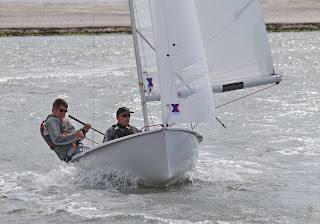
Monday, August 06, 2012

Sail setting for speed

I've read many books and sat through many coaching sessions on how to win races and it seems to me that simply put there are two key aspects- sail the boat fast and sail the fastest route around the course. That's probably where the simplicity ends and things become a little more complicated.
Sailing a boat fast is all about boat handling and sailing the fastest route is all about strategy and tactics. This simple division helps identify the where a crew can initially contribute to the speed of a boat and that is boat handling. Strategy and tactics can be handled by the helm whilst the crew focuses on learning the basics of boat handling. Later the crew can begin to help in the task of finding the fastest route around the course but more on that another time.

Sailing a boat fast requires optimising the power generated by the wind in the sails and turning it to the maximum speed through the water. So whatever direction or manoeuvre that the helm and crew take the boat through they must trim the sails correctly to the wind and at the same time make sure the boat is controlled to minimise drag and use its hull shape to best advantage. This requires a teamwork as well as knowledge of what needs to be done because without a coordinated approach the looked for boat speed will not materialise.

To begin with the crew must understand some basic principles of boat manoeuvres, specifically each point of sailing and then tacking and gybing, because they will need to control a number of aspects of the boats equipment as well as moving to the appropriate position in the boat. 

Points of sailing
This diagram shows the relative angles between the direction of the boat's travel and the wind direction.
The sails need to be set to the right angle to fill and drive the boat through the water. If the sail is not correctly set then it will not work efficiently. Each point of sailing has a name which helps because for each one the controls have general settings and the helm need only say which point of sailing for the crew to know what they should be doing. So for example on a beam reach the jib sail doesn't need to be pulled in tight but just enough for the sail to fill and the centreplate will be about 50% down. On the Albacore we also have shroud levers to let the leeward shroud go slack which helps the mainsail set better and the crew is responsible for this control. (The crew's position will depend upon wind strength and perhaps sea state but the key factor is keeping the boat upright - but more on this later.)

Setting the jib
Setting the sail correctly does require fine tuning, which is always a continuous process because the relative direction of the wind to the boat is always changing and so the crew needs to know just how to set the jib. The first stage is to trim the jib so that it is just filling completely which means that the front edge (the luff) is not backwinding. Then the sail is adjusted to ensure that the jib telltales are flying correctly. The tell tales are small strips of material that are attached to each side of  the sail's surface and they respond to the movement of the air over the surface and so indicate how well the sail is set. The diagram shows the three states: trimmed (just right) luffing (sail need to be pulled in a bit) and stalled (sail needs to be let out a bit)

The crew should be constantly adjusting the sail in and out small amounts whilst watching the tell tales to ensure that the sail is trimmed optimally.

The diagram shows tell tales at different points up the jib and the crew needs to find the best optimum point for all of them which sometimes requires a bit of compromise because the sail's angle to the wind changes because it twists. This twist can be controlled with a jib pole which when deployed pushes the clew of the sail out and down to get the get the best angle of the sail to the wind from the top to the bottom.
This picture shows the jib pole in action. The jib pole is adjustable so needs to be controlled by the crew to get the best out of the jib which can be seen when all the tell-tales are flying right showing that the sail is correctly trimmed all the way up its luff and this maximises the effectiveness of the jib.

When sailing close hauled the jib is normally trimmed fully in and when running downwind the jib is poled out to catch as much wind as possible so on those points of sailing the crew does not need to adjust the sails except when tacking or gybing. But more on that on the next post.


New beginnings

It's been a while since I have written anything on this blog, the last entry was looking at what to look for in a sailing club. Since then I have indeed sold my beloved Wild Goose (E20202) to my eldest daughter who will sail her at Tynemouth Sailing club. I have also purchased an Albacore, 6812 which we have named 'Acushla'  and so far she is proving to be everything we hoped for: plenty of room, fast and interesting to sail (the Albacore is described as a 'technical' boat). Our first race at Ripon  saw us win the handicap race by a healthy time margin, I'm sure some of that is down to being the quickest boat and with a good start it meant we got clean away and sailed in clear air, which makes a massive difference.
On the club front we have had a rethink because the nearest clubs really don't offer a good programme of racing and our work commitments mean that we would not really make good use of the boat. So we widened our search and included inland clubs (we really would prefer to sail on the sea but there are not enough clubs on the coast in our area). We discovered a club that offered a really good programme that suits us just right and its no more than a 35 minute journey from our new home. The East Lancs sailing club sails on a fairly decent sized reservoir and races on Wednesday evenings, Saturdays and Sunday afternoons which means we could quite probably race 3 times a week which is way more than I expected. I'm sure we won't manage that every week but I would hope that we would manage at least the Wednesday evenings and one of the weekend days. So last week I sent of the application for membership and hopefully we will be sailing there within the month.
My crew will be my wife, Sally, who admits to being inexperienced in racing so one of our challenges is to get her up to speed in crewing and develop a good team work together s that we can really get Acushla going quick.
So I plan to do a few blog posts over the next few weeks or so on what a crew needs to know to make a boat go quick.

Saturday, December 31, 2011

What do you look for in a sailing club?

A new year is nearly upon us and it holds and heralds change, new things, new places, the passing away of what is now and the beginings of new adventures.
I have mentioned in my previous post the decision to change boats, selling my Enterprise and buying an Albacore and that we will be moving to a new area. Well I can now say that in August we will be moving to Blackpool where, in September, I will begin work as a Deacon with the Blackpool Methodist Circuit working in two housing estates. We are hoping that Sally, my wife, will also be stationed to the same circuit as a Presbyter to take pastoral chrge of two or more Churches in the Circuit but we have yet to hear of exactly where she will be stationed in the area.
So we will be living in a new area, in a new house, making new friends and discovering new places. We will need to find a new sailing club to join, one that offers us the best combination of accessibility and opportunity to participate in club racing. The search for a new club has begun. Using the Yachts and Yachting website club locator  I have found two clubs really close by; The Blackpool and Fleetwood Yacht club  and Ribble Crusing Club, both within 20 minutes drive and both offering tidal sailing. There are other clubs but the travelling time is significantly longer.
The two clubs offer quite different sailing venues.
BFYC is on a small river, the river Wyre, with a limited sailing tidal window, RCC is on the seafront at Lytham and accesses the sea via a jetty across the saltmarsh and mud but it is not clear what thier tidal sailing window is or if they have one (I suspect they do).  I can envision that with strong winds and big waves launching and landing at RCC could be 'challanging' to the point where sailing is unsafe whereas BFYC would not have the same issue.
One of the problems I have with using their websites to explore them is that their sailing programs seem a bit sparse and I don't know if this is a case of 'everybody knows what's going on' assumption of the webmaster or if they really are that sparse. Neither seem to do much frequent/regular racing on any day other than a Sunday (which is a bit of a problem for us) and of the two BFYC seems to do more. I did note that RCC do use a waterfront lake for 8 races on Wednesday evenings between May and July which would be very good but I'm not sure I want to join a club for the sake of 8 races!
It may be that we have to content outselves with just doing a bit of cruising in which case probably the BFYC offers an interesting area to sail and explore but then equally so might RCC.
In terms of membership RCC has a much lower joining fee the subscription depends on when you join. The BFYC entry fee is the same as the subs and both would apply fully no matter when you join and that's not a good incentive to join in August.
I guess we shall just have to wait and see which one turns out to be the best option. Until then I have much work to do, a boat to prepare for the new season and at least the first half of the season will be sailed at Ripon Sailing Club.

Monday, December 05, 2011

Another season gone!

Crickey Time flies! The lack of posts on this blog is a pretty good indicator of the significant drop in sailing this year and it doesn't look like being any better next year BUT I am still sailing - well not now. The last sail of the year was at the end of October and currently my boat is tucked up in the garage awaiting some winter attention.
This last season has seen some interesting developments - I've managed to win some of the club trophies and even took home a bit of silver from the NWNSA regatta! Very unexpected! I have been sailing a lot more with my wife, Sally, but I have to say that we are finding the Enterprise too small for the pair of us. At some point next season we will be buying an Albacore and selling Goosey. It's sad to let let a much loved boat go but I can't justify keeping her and not sailing her - its the fastest way to see a boat rot! Boats need to be sailed, they come alive when they sail and die a slow death when they are neglected - especially if left out in the elements. Also it looks like we will be moving again next August and so we will need to be looking for a new club in our new location (can't say where just yet - I do know but I am not allowed to publish details) The good news is that we will be able to sail on tidal waters again (so yes near the coast!). So all change again next year.


Thursday, April 21, 2011

Getting my fix

Yep its that time of year again. Time for the highly addictive sailing bug to kick in! And it has. I spent perhaps the shortest time ever preparing a boat for the new season - no more than 10 man days of work, quite possible as few as 7. And it shows. Not the best paint job, not the best varnishing (mind you I think some of that is down to the new 'Compass' varnish) but she looks ok and ... well.... I just want to get sailing so as longs as she is protected from the elements all will be well. The Boat cover did get a good waterproofing treatment which it desperately needed. Unfortunately I did it in the back garden and the grass now has what looks like a giant cloths iron burn on it - I really should believe the warnings on the tin but hey it'll grow back!
One thing I did notice was the rise in the cost of paint and varnish! Wow has it gone up! I estimate a 15% jump in a year. However I think it is still a relatively cheap sport/hobby, Insurance £50, club membership £150, Enterprise Association £25, and maintenance cost approx £100, total approx £275 and that should keep it on the water all season. No doubt there will be other costs but not a great deal.
I took Goosey down to the club yesterday late afternoon and rigged her up and had a quick sail in the very calm conditions. A few little things to tweak but she's in good shape for the season. I won't be doing much trailing this year due to financial and time constraints but we hope to do Norfolk week in the summer.

Tuesday, March 01, 2011

Boat work begins

Saturday 26th February. In need of head space, fresh air and something else to do, and with the sunshining away like mad I decided to do some boat work. So I wheeled the old girl out of the garage and with my daughters help I began the task of removing all the fittings, inspecting and and cleaning, packing the bits away so that I can find them all again when the vital painting and varnishing has been completed.
I have noticed that sometimes screws fool you. You think you have put in nice decent stainless steel screws and what happens? One rusts and another sheers! The rusted one did eventually come out but the other has left me with a slight problem - a screw stuck in the wood and I don't want to even try digging it out. So now, when I replace the fitting, I have to somehow resite it in such a way that it all still works. All good fun. I'm sure I'll work it out.

Oner of the things I am aware of is the need to keep an eye on all those areas that are showing signs of water ingression. The tell tale signs is a darkening of the wood, but in a boat of over 30 years of hard sailing there are quite a few places where the damage has been done but its not getting any worse. So I'm looking at a few of the black bits; on the hog just at the back of the centreboard casing and a bit near a knee on the port side, midway, and wondering if there has been any change since last year - has the dark bit grown? What do I do if it has? I guess at some point I'll get a boat builder to take a look at it and see if any remedial action is needed. But for now it will be ok for another season.

So having removed all the fittings a good wash out with the hose removes the grit and grim of the last seasons sailing and now she is ready for the prep work - the sanding down - filling and any remedial work that needs doing (and there isn't much) - and then she can be painted and varnished.
I can't do much until April when I have more time and the weather is warm enough to allow the paint and varnish to dry but little by little we shall get there. I'm aiming to get it done so that we can do some sailing in the latter half of April.

Tuesday, December 07, 2010

Cold Turkey

The sailing season finished at the end of October. Wild Goose is now tucked away in the garage, safe from the horrid snow and ice (all except the mast which is hanging from fence posts and waiting for me to strip down and protect).
For the last two months I've had my head in books studying and the last month has been a little more manic with essays to write so I have not thought too much about it but today I have been thinking 'How good it would be to go sailing' - but not in this weather! I hear the hardy types saying 'Do the winter series' and I could have done a winter series but my wife doesn't do winter sailing and I am not so keen on it either, plus drysuits are just a tad too expensive.

So Youtube sailing vids it is then.....until the new season begins! Ah Boat work first. Well that's something to look foward too.

Tuesday, August 03, 2010

NWNSA 2010

This last week I took part in the North West Norfolk Sailig Association regatta, crewed for the first time by my wife, Sally. But rather than me telling you stuff in my usual way I thought I would point you at Sally's account written up on her Blog: Eternal Echoes.

maybe I will write something later.

TTFN